Industrial Automation


Automated greenhouses and vertical farms require processes that are controllable, repeatable and reliable. From microclimate regulation and nutrient solution distribution to crop handling, every stage depends on the coordination of multiple systems. SMC automation and fluid control technologies help designers and operators manage these requirements with greater precision.

Automated greenhouses and indoor farming: what requirements must a facility meet?
Controlled environment agriculture (CEA) is based on managing the conditions in which plants grow. Its aim is to keep the factors affecting crop development under control through regulation, monitoring and automation systems.
In high-tech greenhouses, growth chambers and vertical farms, temperature, humidity, air circulation, CO₂ concentration and nutrient supply are interconnected parameters. A change in one part of the facility can affect other stages of the process.
The challenge for those designing or operating these facilities is to maintain conditions as uniform as possible and respond promptly when parameters deviate from the values required for a particular crop.
The ability to schedule production cycles with less dependence on outdoor weather conditions is one of the advantages of CEA. To make this approach operationally sustainable, however, facilities must be reliable, resources must be carefully managed and technologies must work together effectively.


Vertical farms: integrating systems is as important as controlling individual parameters
Growing crops on multiple levels makes it possible to use space differently from conventional agricultural layouts. At the same time, it makes coordination between air treatment systems, irrigation lines, nutrient supply and handling equipment even more important.
Uneven air distribution can create different conditions between growing levels. Similarly, inconsistent CO₂ or nutrient solution delivery can affect the uniformity of crop growth.
Complexity increases when environmental control is combined with automated sowing, transplanting, transfer and harvesting operations: movements must be repeatable and gentle enough for delicate plants.
Another factor to consider is the ability of systems to withstand humidity, condensation and the typical conditions found in growing areas, which can affect component reliability and maintenance frequency.
For this reason, vertical farm design should consider the entire process chain: from parameter measurement and regulation to movement execution and data collection.
Applying SMC expertise to growing processes
Indoor agriculture draws on established industrial automation expertise in air and gas control, fluid regulation, motion actuation and communication between devices.
SMC addresses these requirements with a process-oriented approach, providing technologies that can be integrated into the different functions of automated greenhouses and CEA systems. The starting point is not an individual component, but the function that the facility must perform consistently and reliably.
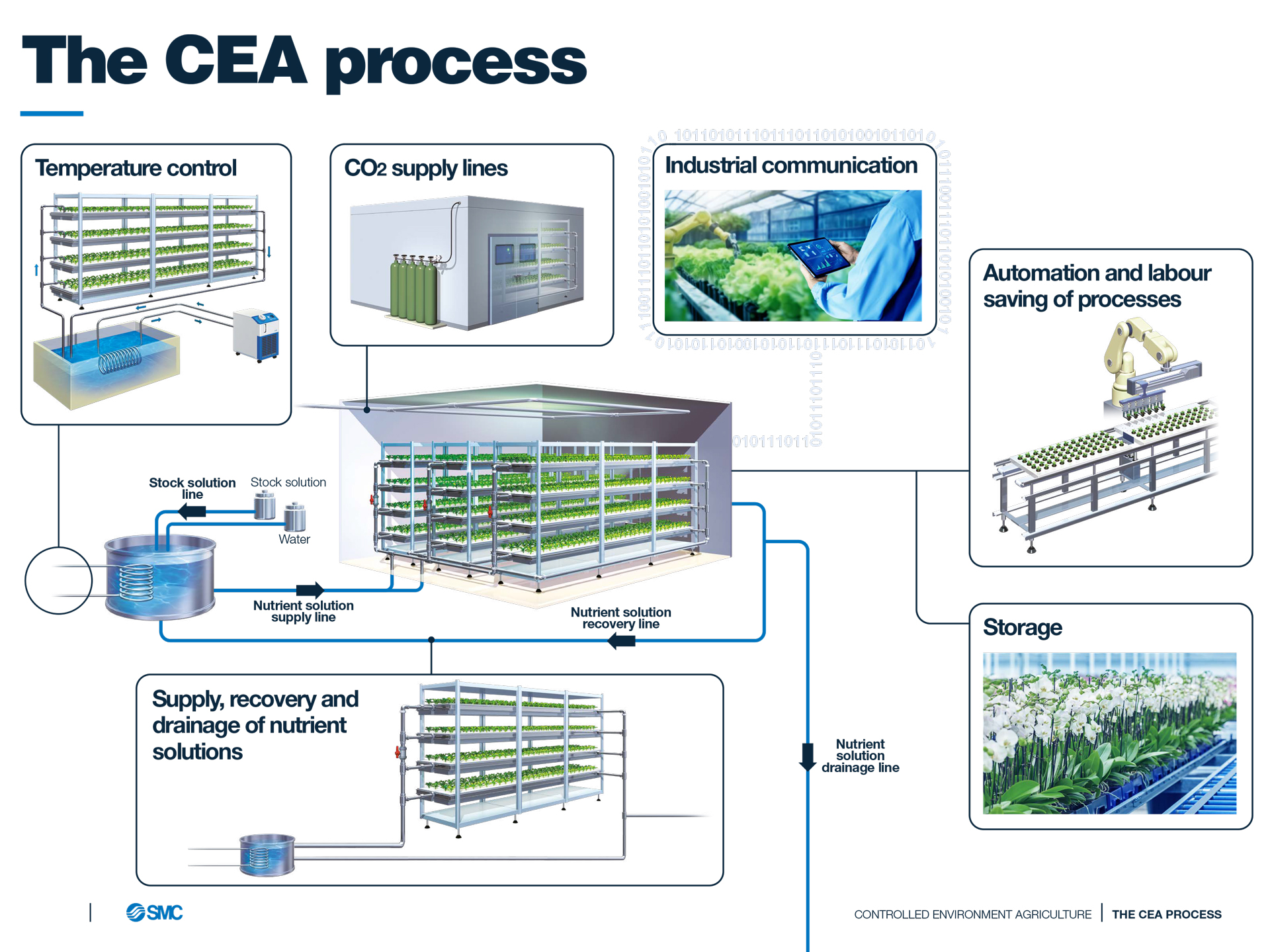
Microclimate control and regulated CO₂ distribution
Managing the microclimate means minimising unwanted differences between growing areas and maintaining the conditions required at different stages of plant development.
Regulating airflow, pressure and gas distribution helps achieve this goal. In particular, CO₂ supply must be controlled so that its concentration remains appropriate for the growing process.
SMC expertise in flow and pressure control, gas treatment and fluid temperature management can support integration with climate and environmental control systems.
Water, irrigation and fertigation
In indoor growing systems, water and nutrients must reach the intended areas at flow rates and dosages suited to the facility’s requirements.
Inaccurate regulation can lead to differences in plant nutrition and increased resource consumption. It is therefore important to consider the entire circuit, including nutrient solution supply, distribution, recovery where applicable, and drainage.
SMC offers fluid control technologies that help manage these functions and monitor line operating parameters. The aim is to support more stable and measurable irrigation and fertigation processes, adaptable to the characteristics of the crops and the facility.
Operational continuity in humid environments
Condensation, water, high humidity and washdown operations are among the conditions that must be considered when selecting technologies for an indoor agricultural facility.
Materials, protective features and compatibility with the fluids used must be appropriate for each application to prevent operating conditions from compromising system durability and reliability.
SMC solutions for demanding environments help reduce the risk of component-related malfunctions and downtime as part of sound facility design and maintenance practices.
Automated crop handling
In an automated greenhouse or vertical farm, certain stages involve frequent, repeatable movements: repositioning growing benches, transferring seedlings, sowing, transplanting and harvesting.
Integrating suitable handling systems can reduce manual intervention in repetitive tasks and make operational sequences more predictable.
SMC technologies for pneumatic and electric actuation, gripping and motion control can be used to develop automated solutions that take into account crop characteristics and operating conditions.
The goal is a handling process that is precise, repeatable and coordinated with the facility’s other functions, rather than simply faster.

Process data and connectivity for more effective control
Measuring a parameter is most useful when that information can be used to adjust facility operations.
Monitoring flow rates and pressures, alongside the status of devices and handling systems, makes it possible to identify deviations and check whether the different lines are operating within the intended conditions.
Industrial communication technologies in the SMC portfolio, such as IO-Link, wireless systems and serial interfaces, support connectivity between sensors, devices and automation architectures.
Greater data availability facilitates continuous monitoring, diagnostics and maintenance planning. For designers and facility managers, this means gaining visibility into the process as a whole rather than just its individual elements.
Operational efficiency: start with the facility’s actual requirements
In controlled environment agriculture, efficiency does not depend on a single technology. It results from decisions about fluid distribution, environmental management, motion automation and process organisation.
Accurate control can help minimise water, nutrient and gas waste. Automation can reduce repetitive manual tasks, while diagnostics can support a faster response to anomalies.
These benefits must be assessed in the context of the specific installation, taking overall energy demand and maintenance needs into account.
The most effective approach is therefore to identify critical points in the production cycle and select the control and automation functions that genuinely improve stability, continuity and resource management.
Technology BSA and SMC: automation solutions for greenhouses and vertical farms
Developing indoor agriculture facilities requires expertise from several fields, from process engineering to industrial automation.
For machine builders, system integrators and companies developing or upgrading growing systems, technology selection must begin with operating conditions and application objectives.
Technology BSA offers SMC solutions for fluid control, motion and industrial communication, supporting the different functions found in automated greenhouses and vertical farms.
From gas regulation and nutrient solution management to monitoring and automated operations, the focus is on integrating reliable technologies into growing processes.
Are you designing an automated greenhouse or vertical farming facility?
Discuss your project requirements with Technology BSA and explore potential applications of SMC technologies in controlled growing processes.
Complete the form: the Technology BSA team will contact you to discuss your application and identify the most suitable technical solutions.