SMC’s 4-Bar Factory can transform industrial plants by reducing energy consumption by up to 20%.
Energy efficiency is no longer an option—it is a strategic lever for industrial competitiveness.
In today’s industrial landscape, the transition toward sustainable production models is a top priority.
With the European Union outlining a clear roadmap toward carbon neutrality by 2050, companies are required to drastically reduce emissions.
However, sustainability must go hand in hand with economic competitiveness. This is where the revolutionary concept of the 4-Bar Factory comes into play.

Listen to the podcast dedicated to the 4-Bar Factory
Compressed air: a valuable (and costly) resource
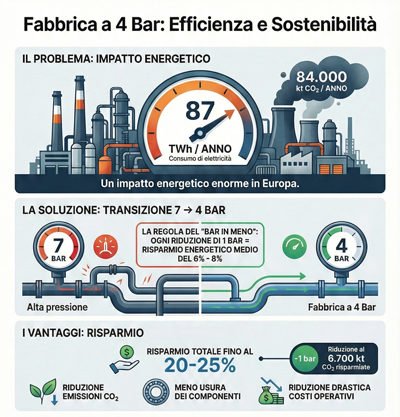
Often referred to as the industry’s “fourth utility,” compressed air represents a major cost factor. In Europe, it is estimated that around 87 TWh of industrial electricity are used to generate compressed air, resulting in 84,000 kt of CO₂ emissions per year.
Traditionally, plants operate at pressures of 6 or 7 bar, often based on legacy settings or to compensate for leaks and demand peaks. However, maintaining such high pressure entails significant energy waste. The rule is simple: for every 1 bar reduction in supply pressure, average energy consumption decreases by 6–8%.
Why move to 4 bar?
SMC’s proposal—our reference partner for Technology BSA, is bold yet practical: lowering the plant’s standard operating pressure to 4 bar.
Reducing pressure from 7 to 4 bar is not a simple adjustment, but a strategic shift that can deliver overall energy savings of 20–25%.
The benefits are multiple
- Reduced operating costs: less work for compressors means lower energy bills.
- Lower losses: reduced pressure decreases the volume of air lost through system leaks.
- Reduced maintenance: pneumatic components operating at lower pressure experience less stress, extending their service life.
- Sustainability: a direct reduction in CO₂ footprint, aligned with ESG objectives.
How to implement the change: a gradual approach
We know resistance to change is strong—“We’ve always done it this way,” or “The machines will slow down.”
SMC and Technology BSA propose a structured, methodical approach to ensure productivity remains unchanged.
The transition to a 4-Bar Factory takes place through clearly defined phases.
1. Analysis and Monitoring
Before lowering the pressure, measurement is essential. Demand peaks and inefficiencies must be identified first.
2. Local optimization
Pressure drops are often caused by sudden demand peaks. By installing local reservoirs or regulators close to the point of use, supply can be stabilized without maintaining high pressure throughout the entire plant.
The right pressure in the right place
What if a specific application requires higher force? There’s no need to increase the pressure across the entire factory. Pressure boosters can locally increase force (up to four times) only where needed, while keeping the main line at 4 bar.
Future-ready technological solutions
Many modern components are already designed to perform at their best at lower pressures. Through the SMC catalog available from Technology BSA, it is possible to access enabling technologies such as:
- Optimized actuators: cylinders with reduced friction or properly sized bores to maintain the required force even at 4 bar.
- ZL series vacuum generators: optimized to operate with a supply pressure of just 3.5 bar.
- Angle seat valves: designed to operate at pressures as low as 3 bar.
- High-efficiency blow nozzles: designed to maximize air impact while reducing volumetric consumption.
A real success story
The effectiveness of this approach is proven by real-world results. At SMC’s Shimotsuma plant (Japan), the gradual adoption of the 4-bar standard led to a 20% reduction in annual air consumption and a cut of 12 tons of CO₂ emissions per year, without compromising production.
Reduce your plant’s energy costs by up to 20%
Compressed air accounts for around 10% of industrial energy consumption, but it is often wasted due to excessively high operating pressures. The rule is simple: reducing pressure by 1 bar means cutting energy costs by 6–8%.
Technology BSA, in partnership with SMC, helps you meet the challenge of the “4-Bar Factory”. Through consumption analysis and the adoption of optimized technologies, we can help you reduce energy bills and CO₂ emissions without compromising machine productivity.